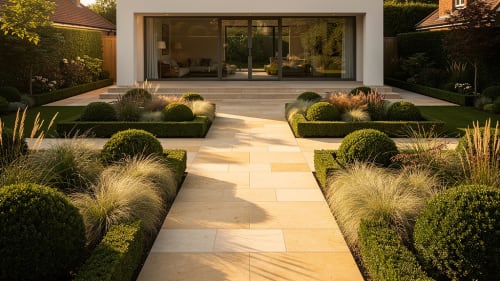
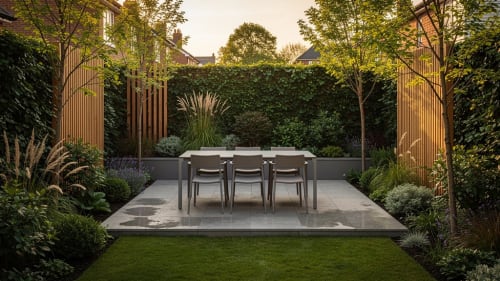
The internet is full of garden inspiration. Scroll through any platform and you’ll find thousands of beautifully photographed outdoor spaces — slate-grey patios, ornamental grasses, fire pits surrounded by carefully placed boulders. What you won’t find is anyone explaining why some of those gardens will still look good in ten years and others will look tired in three.
That distinction matters. A garden isn’t a kitchen — replacing it every decade is disruptive and expensive. The plants grow, the materials weather, the ground settles. What you put in place today is what you’ll be living with for a long time. So it’s worth understanding what makes garden design actually work, rather than just what makes it photograph well on a Tuesday afternoon in June.
Principles, Not Trends
Good garden design draws on the same spatial principles that underpin architecture and interior design — scale, proportion, rhythm, and the relationship between elements within a space. These are well-established in design theory, and they’re the reason a garden feels comfortable or cramped, inviting or chaotic, restful or restless.
Scale is about the relationship between the size of elements and the size of the space. A two-metre water feature in a courtyard garden overwhelms; the same feature in a half-acre plot can anchor a view. Getting scale right requires understanding how people actually experience a space — not how it looks from above on a plan, but how it feels when you’re standing in it.
Proportion works alongside scale but addresses the balance between different areas. How much of the garden is hard surface versus planting? Where does the eye travel? Is there enough open space to breathe, or has every square metre been filled? Over-designed gardens are as common a problem as neglected ones — the impulse to fill every gap often produces spaces that feel cluttered rather than generous.
Seasonal structure is where many gardens fall short — and this is where practitioner experience speaks more clearly than theory. Having maintained our own builds across Surrey for decades, we see which gardens hold their own in January and which look abandoned. The pattern is consistent: the ones that last are designed around structure first, colour second. Evergreen framework, form, texture, bark, seedheads — these carry a garden through winter. A design that relies on summer flowering for its impact gives you three good months and nine disappointing ones. That said, the balance between structural planting and seasonal colour is partly a matter of preference and site — there’s no single formula.
The Soil and Site Come First
Before any design conversation about style, materials, or planting, there are practical questions that determine what’s actually possible. What’s the soil like? How does water move through the site? Which direction does it face? Where does the sun fall at different times of day and different times of year? What are the existing trees doing to the light and the root space?
These aren’t secondary considerations — they’re the foundation. A south-facing garden in free-draining sandy soil presents completely different opportunities and constraints than a north-facing clay plot. Designing without understanding site conditions is guesswork, and guesswork gets expensive when plants fail, drainage backs up, or paving settles unevenly.
In Surrey, soil conditions vary considerably over short distances. You can move from heavy Weald clay around Guildford and the southern parts of the county to lighter greensand soils further north. In our service area — Woking, West Byfleet, Chobham, the Ascot corridor — we often encounter different conditions on neighbouring properties. Fifty years of building on these soils gives us a practical database that no soil survey alone provides, though we’d always recommend testing on any significant project.
Designing for How People Actually Live
The most common disconnect in garden design is between how a garden looks and how it’s used. A perfectly symmetrical layout with immaculate planting looks wonderful in photographs, but if you have children, a dog, and a preference for eating outside three months of the year, it may not serve you particularly well.
Good design starts with honest questions about lifestyle. How do you move through the space? Where do you sit? When do you use the garden — mornings, evenings, weekends? Do you want to maintain it yourself or would you rather someone else handled that? Is this a garden for entertaining, for play, for quiet, for growing food, or some combination?
The answers shape everything. A family with young children needs different things from a retired couple. A keen gardener needs different things from someone who wants beauty without the labour. Neither is more valid — but designing for the wrong user produces a garden that looks right and feels wrong. This is something you can evaluate yourself: if a designer isn’t asking detailed questions about how you live before showing you mood boards, that’s a warning sign.
Why Some Gardens Age Well and Others Don’t
After 50 years of designing, building, and maintaining gardens across Surrey, certain patterns become clear. These are practitioner observations — drawn from watching our own projects age, not from formal research — but they’re remarkably consistent.
Quality materials weather gracefully. Natural stone develops character over time. Good timber silvers and patinas. Cheaper composite materials tend to fade, crack, and date — though material science is improving, and some newer composites perform better than their predecessors. The upfront cost difference is real, but so is the twenty-year outcome.
Planting schemes need room to mature. One of the most common mistakes is planting for immediate impact — filling every space so the garden looks finished on day one. Plants grow. A well-designed scheme accounts for where things will be in five years, not just where they are when they go in the ground. This requires patience from the client and honesty from the designer — the garden won’t look complete immediately, but it will look better in year three than one designed for instant gratification.
Maintenance reality matters. Every garden needs care, and a design that requires more maintenance than the owner is willing to provide will deteriorate. This isn’t a failure of the garden — it’s a failure of the design process to account for real life. Honest conversation about maintenance expectations at the design stage prevents disappointment later. When we design, we ask directly: how many hours a week will you realistically spend out here? The answer changes the plan.
Structure outlasts style. The gardens we maintain that were built twenty or thirty years ago — the ones that still look good — are the ones with strong bones. Good walls, well-laid paths, considered levels, mature framework planting. The fashionable elements of their era may have been updated, but the underlying structure endures. That’s what good garden design delivers: a framework that can evolve over decades without needing to be demolished and rebuilt.
The Value of Getting It Right
There’s a reason people seek out a garden designer near them rather than attempting a significant project alone. It’s the same reason you’d use an architect for a house extension — the expertise isn’t just creative, it’s practical. A designer who also builds and maintains gardens understands materials, drainage, soil, plant behaviour, construction methods, and the dozens of small decisions that determine whether a garden works or merely looks like it should.
Getting those decisions right from the beginning is more efficient and less costly than fixing them afterwards. And a garden designed around principles rather than trends has the best chance of being something you genuinely enjoy — not just next summer, but for years to come.
If you’re thinking about a garden project, see how we approach the planning and design process. For a deeper look at how contemporary trends translate into real gardens, read our piece on contemporary garden design in Surrey.
Ready to talk about your garden? Get a free quote.