There's a persistent assumption in garden design that small spaces are a compromise — that the real work happens in larger plots and small gardens are somehow lesser projects. The opposite is closer to the truth. In a large garden, you can get away with a mediocre decision because there's space to absorb it. In a small garden, every choice is visible, every proportion is felt, and a single misjudgement can undermine the whole space.
That's precisely why small gardens benefit more from considered design than large ones. And in Surrey — where Victorian and Edwardian terraces in towns like Guildford, Woking, and Weybridge often pair significant houses with compact outdoor spaces — getting it right matters.
The Core Problem: Trying to Fit Everything In
The most common mistake in small garden design is attempting to include every element from a larger garden at a reduced scale. A tiny patio, a narrow strip of lawn, a small raised bed, a miniature water feature, a compact shed, a barbecue area — each individually reasonable, collectively chaotic.
The result is a garden that feels like a storage room: full of things, impossible to relax in. The eye has nowhere to rest because every surface is occupied by a different element demanding attention.
The discipline small gardens require is editing. Not "what can we fit in?" but "what do we actually need, and what can we let go of?" In our experience, a small garden that does two things well is more successful than one that attempts six things badly.
This starts with honest conversation about priorities. How will the space actually be used? If outdoor dining matters most, design the garden around that — give it a properly sized table area with comfortable access, and let the rest support it. If the priority is planting and greenery, commit to that and accept that the hard landscaping needs to be minimal. If it's a play space for children now that will evolve later, design for flexibility.
The answers are different for every household, and they should be. The design follows the life, not the other way around.
Principles That Work in Small Spaces
The following principles are established garden design practice — well-documented in the design literature (Brookes, Oudolf, and others) and consistently validated across our own work in Surrey over five decades. They aren't theoretical; they're what we see working, project after project.
Fewer materials, more continuity
In a small garden, every material transition — where paving meets lawn, where timber meets stone, where one surface ends and another begins — is a visual interruption. In a large garden, these transitions are spaced far enough apart to feel natural. In a small one, too many changes fragment the space and make it feel smaller.
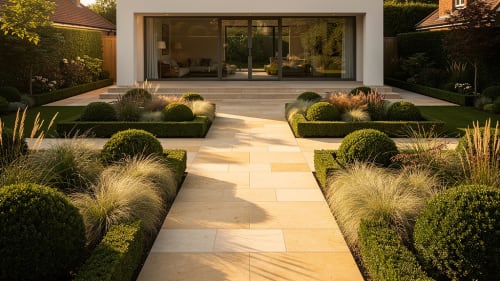
Using two or three materials consistently throughout creates visual continuity. The eye moves through the space rather than stopping at every boundary. A single well-chosen paving material running from the house to the far boundary, for instance, makes a short garden feel longer than alternating surfaces would. On Surrey's clay soils, choosing materials that handle wet-dry cycling without shifting — properly laid porcelain or natural stone on a concrete base rather than budget slabs on sand — matters more in a small space where any unevenness is immediately visible.
Vertical thinking
Small gardens have limited floor area but unlimited vertical potential. Climbers, trained fruit trees, green walls, raised planters at varying heights, overhead structures — all add volume and interest without consuming ground space.
A garden that uses its vertical dimension well feels larger than its footprint suggests, because the experience isn't confined to a single plane. You look up, across, through foliage, under a pergola. The journey through the space has depth even when the distances are short.
Wall-mounted planters and espalier-trained trees are particularly effective in Surrey's walled and fenced gardens, turning boundary surfaces from barriers into features.
Diagonal and curved lines
A rectangular garden measured in a straight line from house to back fence feels exactly as long as it is. The same garden with a diagonal path, an angled patio, or a curving border feels longer, because the eye follows the longer line.
This is one of the oldest principles in garden design — it appears in every foundational text from John Brookes onwards — and it works as well in a Woking courtyard as anywhere. Small gardens designed on the diagonal gain apparent space without any physical change to the boundaries.
One generous gesture
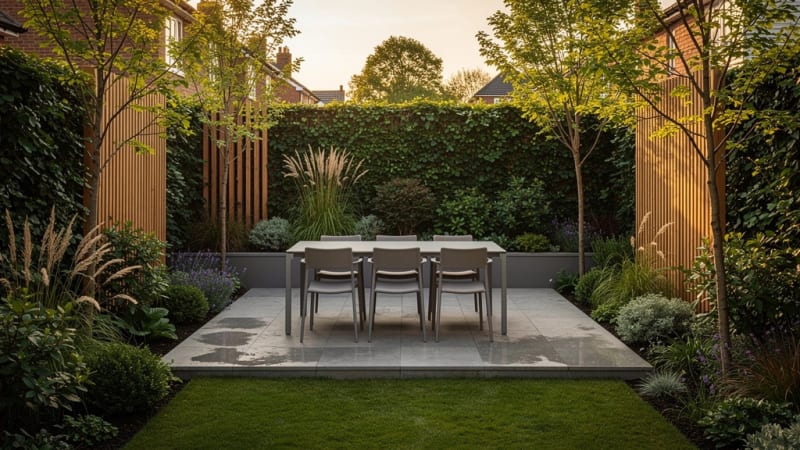
Rather than dividing a small garden into multiple tiny zones, consider making one element deliberately generous. An oversized planter, a specimen tree with real presence, a dining table that properly seats six — one element that refuses to be diminished by the scale of the garden gives the whole space confidence.
The psychology is counterintuitive, but it's a consistent observation across both interior and landscape design practice. People assume small spaces need small things. But a single large, beautiful element in a small garden creates a sense of intentional abundance rather than cramped compromise. The key is choosing one — not three.
Borrowed views
If there's anything worth looking at beyond your boundary — a neighbour's mature tree, a church tower, open sky, distant hills — design to include it rather than screen it out. A carefully placed gap in planting or a lowered fence section can extend the perceived garden well beyond its actual limits.
In parts of Surrey, the surrounding landscape is a genuine asset. Gardens near the Surrey Hills, the Wey Valley, or areas with mature tree canopy have visual resources beyond their boundaries that can be incorporated into the design. Screening everything out for privacy sometimes costs more in perceived space than it gains in seclusion.
Common Mistakes Worth Avoiding
Miniaturising everything. A path that's too narrow to walk comfortably, a patio that barely fits two chairs, a lawn the size of a bath towel — scaling everything down proportionally doesn't work. Some elements have minimum functional dimensions. A path needs to be wide enough to walk without brushing plants on both sides. A dining area needs to accommodate chairs being pulled out. These aren't luxuries; they're the difference between a garden that works and one that frustrates.
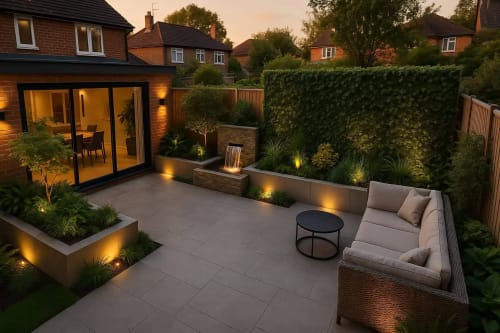
Neglecting lighting. Small gardens are often overlooked at night. But a well-lit small garden can feel like an additional room in the evening — extending the usable hours and the perceived space of the home. A few carefully placed lights (up-lighting a tree, washing a textured wall, marking a path) can make a small garden feel more generous after dark than it does in daylight.
Ignoring the view from inside. Most small gardens are seen from the house more often than they're stood in. The view through the kitchen window or the back door matters enormously. Design the garden to look good from the primary indoor viewpoints, not just from the centre of the patio.
The Small Garden Advantage
Small gardens have something working in their favour that larger plots don't: intimacy. A well-designed small garden creates a sense of enclosure and atmosphere that a large, open space struggles to achieve. Every plant is close enough to notice. Every detail — the texture of a wall, the grain of timber, the scent of a climber — is experienced directly, not from a distance.
The gardens we find ourselves returning to most often in our maintenance work aren't always the largest. Some of the most satisfying spaces we've designed and built across Surrey have been the most compact — where the constraints forced clarity about what mattered, and the result was a garden with real character rather than a collection of compromises.