If you’ve ever searched “does landscaping add value,” you’ll have found plenty of confident answers. Landscaping adds 20% to your property value. Gardens deliver a 77% return on investment. Every pound you spend comes back threefold.
These numbers are everywhere. They’re also, for the most part, untraceable.
We’ve spent over fifty years designing and building gardens across Surrey. We believe good landscaping adds real value — but we think you deserve an honest look at what the evidence actually supports, rather than numbers plucked from thin air.
What the Research Does Tell Us
The general principle is well-supported. Peer-reviewed studies — including Gibbons, Mourato and Resende’s analysis of roughly a million English housing transactions — confirm that green space and gardens attract measurable price premiums. An ONS study using over a million Zoopla property records reached similar conclusions. Gardens add value. That much is solid.
What’s less solid is the specific percentage.
The commonly cited “20% property uplift” is most often attributed to Foxtons estate agents. After extensive searching, no original publication with methodology, sample size or date can be found. It appears to be a plausible-sounding figure that has been repeated so often it’s treated as fact. The “77% ROI” statistic, from a 2019 Post Office Money survey, is based on what homeowners believed their improvements were worth — not on actual transaction data.
Professional consensus, drawn from RICS surveyors and estate agents with market experience, puts the realistic impact of garden quality at roughly 5–15%. That’s a wide range because context matters enormously: the type of property, its location, the existing state of the garden, and what buyers in that market expect.
The Penalty for Neglect Is Clearer Than the Premium for Excellence
Here’s something the evidence supports more strongly: a neglected garden actively reduces your property’s value. The Husqvarna Global Garden Report — a controlled study showing 5,000 participants identical houses with different garden quality — found that 70% of estate agents believed unkempt gardens lower prices by 5–15%.
A HomeOwners Alliance survey of over 2,000 UK adults found 67% of homebuyers rate a tidy front garden as important in their purchasing decision. Marshalls found 60% of viewers form an opinion within one minute of seeing the exterior.
In other words, the strongest financial case for maintaining your garden isn’t the potential upside — it’s avoiding the well-evidenced downside. Neglect is expensive.
What This Means in Surrey
At Surrey price levels, even modest percentages translate to significant figures. The average Surrey property sits at roughly £587,000, according to Land Registry data. Apply that 5–15% range, and garden quality could represent £29,000–£88,000 in value terms. On properties above a million — common in areas like Cobham, Esher and Virginia Water — the potential impact rises accordingly.
Surrey also has some of the largest residential gardens in England. ONS data shows Waverley averaging 653 square metres, Tandridge 639, and Mole Valley 595. When your garden is that substantial, it isn’t background — it’s a defining feature of the property.
But Surrey’s planning environment adds a layer of complexity. With Green Belt covering 73% of the county, over 200 conservation areas, and the Surrey Hills National Landscape restricting development across large swathes of the south and centre, even straightforward projects may need careful navigation. Tree Preservation Orders are extremely common in what is England’s most wooded county. Before any significant garden project, checking the specific designations affecting your property through your borough council’s planning portal is an essential first step.
Materials Matter More Than Most People Realise
One area where the evidence is genuinely strong is material longevity and lifecycle costs. The cheapest option to install is rarely the cheapest to own.
Take decking. Softwood timber costs roughly £20–£40 per square metre for materials and lasts 5–15 years with annual sanding, staining and sealing. NeoTimber’s 25-year maintenance cost analysis puts the total at over £2,300 for upkeep alone. Composite decking costs roughly double upfront but needs only occasional cleaning — total maintenance over 25 years sits around £414. Manufacturer warranties reach 25–50 years on premium lines.
For paving, porcelain has emerged as a strong performer in UK conditions. Water absorption below 0.5% makes it effectively frost-proof, stain-resistant and fade-proof. Over 30 years, a porcelain patio’s total cost of ownership — including installation and maintenance — can be lower than Indian sandstone despite a similar or slightly higher installation cost, because sandstone requires regular sealing at £8–£15 per square metre.
We see this play out on our own projects. Gardens we built fifteen or twenty years ago with quality materials still look the part; ones where clients opted for cheaper alternatives have often needed replacing entirely. Surrey’s clay-heavy soil and wet winters are particularly unforgiving on porous paving — something the published data supports, and our experience confirms.
The DIY Question
For soft landscaping — planting, painting fences, basic lawn care — doing it yourself makes good sense. The materials are forgiving, mistakes are recoverable, and the skill threshold is achievable.
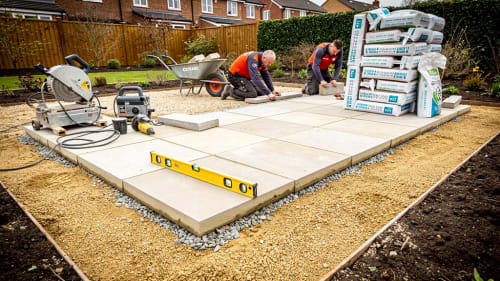
For hard landscaping, the financial case for DIY is weaker than it appears. A 20-square-metre Indian sandstone patio costs £900–£1,500 in materials, but add tool hire, skip costs and materials waste and the realistic DIY total reaches £1,390–£2,425 — surprisingly close to the £1,600–£2,400 a professional would charge for the complete job. The professional version comes with public liability insurance, workmanship guarantees, and legal protections under the Consumer Rights Act that DIY work doesn’t.
The critical failure points — poor sub-base compaction, incorrect drainage falls, inadequate jointing — are invisible problems that only reveal themselves months or years later. We’ve been called in to re-do enough patios built over a single weekend to know that the savings rarely survive the first winter.
Where to Start: The First £1,000
If the full-scale project isn’t in the budget right now, the evidence consistently supports focusing initial investment on cleaning and kerb appeal. A pressure washer hire and a weekend’s effort can transform a patio, driveway, paths and fences for under £100. Add £200–£400 of strategic planting in visible borders, edge the lawn, and you’ve created a noticeably more “designed” appearance for a fraction of a full redesign.
The RHS recommends buying small plants — they establish quickly and catch up with larger specimens within a few years. Several designers advocate the principle of splurging on hardscaping and saving on plants: the structural elements define a garden’s character, while planting can be added and adjusted over time.
The Honest Answer
Does landscaping add value? Almost certainly yes. Can anyone guarantee you a specific percentage return? No. The industry’s most commonly quoted figures don’t hold up to scrutiny, and anyone promising you “20% added value” is quoting a number that can’t be traced to reliable research.
What the evidence does support is this: a well-maintained garden protects your property’s value, a neglected one reduces it, first impressions measurably influence buyers, and choosing the right materials can save thousands over a garden’s lifetime. At Surrey price levels, where even a conservative 5% impact represents tens of thousands of pounds, these are not trivial considerations.
The best reason to invest in your garden, though, is simpler than any of this. You’ll use it every day. The financial case is a bonus.
The value comes from quality materials and expert execution — exactly what our garden landscaping service delivers across Surrey. See what a complete transformation looks like in our luxury garden project in Cranleigh.
For more on how Surrey’s changing climate affects long-term garden value, read what Surrey gardens need now.
Considering a garden investment? Get a free quote.