Companion planting has a reputation problem. Half the internet treats it as gardening gospel and the other half dismisses it as folklore. The truth, as usual, is somewhere in the middle. Some pairings have genuine evidence behind them. Others are repeated so often that nobody questions whether they actually work. And almost none of the standard advice accounts for local conditions.
We've been planting and maintaining gardens across Surrey for over 50 years. We've seen what thrives together and what doesn't in this county's specific soil types, climate, and pest pressures. What follows is based on that practical experience, supported by research where it exists, and honest about uncertainty where it doesn't.
What companion planting actually does
There are three mechanisms that have genuine scientific support.
Trap cropping uses a sacrificial plant to draw pests away from the crop you care about. Nasturtiums attracting aphids away from beans is the classic example, and it's well documented. The RHS has confirmed this approach works for several common pest-plant combinations. The key is that you need to accept the trap crop will get damaged. That's the point.
Pest confusion works by mixing plant species so that pests relying on visual or scent cues struggle to find their target. Monocultures (large blocks of a single plant) are easier for pests to locate. Interplanting disrupts that. Research published in ecological journals has consistently shown that mixed plantings have lower pest loads than monocultures, though the degree varies by species.
Attracting predators is where companion planting overlaps with the broader principle of habitat gardening. Planting flowers that attract hoverflies, lacewings, and parasitic wasps near vulnerable crops gives those predators a reason to be in the area. Umbellifers (fennel, dill, yarrow) are consistently the most effective at this.
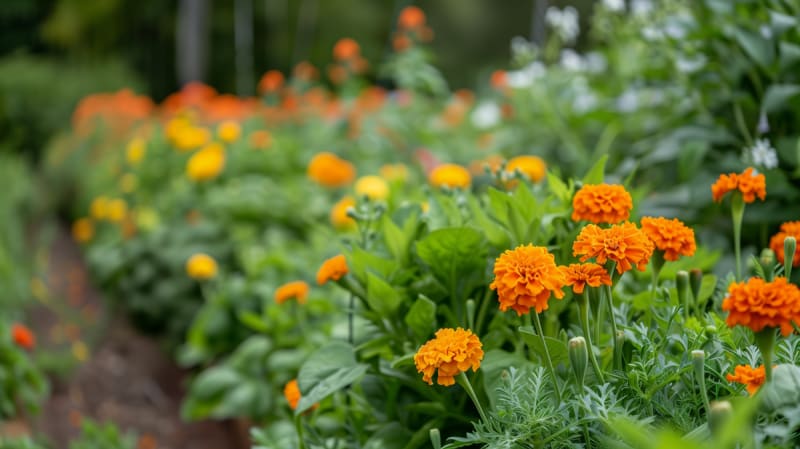
What companion planting probably doesn't do, despite popular claims, is "repel" pests through scent alone. The idea that marigolds repel whitefly from tomatoes, for example, has limited evidence in open garden conditions. French marigolds (Tagetes patula) do produce compounds that suppress root-knot nematodes in soil, which is genuine and useful. But the broader "strong smells confuse pests" claim is overstated for most garden situations.
Surrey-specific pests and what to pair against them
Surrey has some particular pest pressures that generic companion planting guides don't address.
Box tree moth (Cydalima perspectalis) has been devastating box hedging across the county. There's no companion planting solution for this. We mention it because it's important to be honest about the limits of the approach. If your box is under attack, you need Bacillus thuringiensis (Bt) sprays timed to larval emergence, pheromone traps for monitoring, and possibly replacement planting with resistant alternatives like Ilex crenata or Taxus baccata. We've helped several clients through this transition and it's increasingly common across our maintenance rounds.
Vine weevil (Otiorhynchus sulcatus) is a serious problem in Surrey, particularly in containers and raised beds. The adults feed on leaf edges (you'll see characteristic notching) while the larvae destroy root systems underground. Companion planting won't solve vine weevil, but biological controls (nematode drenches, specifically Steinernema kraussei applied in spring and autumn) are effective. What companion planting can do is support ground beetle populations, and ground beetles do eat vine weevil larvae. Undisturbed ground cover, log piles, and dense low planting all help.
Lily beetle (Lilioceris lilii) is bright red and unmissable. It attacks lilies and fritillaries and has become increasingly common across Surrey. There's no companion planting defence, but it's one case where hand-picking genuinely works because the beetles are easy to spot. Check plants from April onwards.
Rosemary beetle (Chrysolina americana) feeds on rosemary, lavender, sage, and thyme. It arrived in the UK in the 1990s and is now established across the southeast. Interestingly, growing these herbs in mixed plantings rather than dense monoculture blocks can reduce damage, because the beetles find large patches more easily than scattered individuals.
Aphids remain the most common pest on our maintenance rounds. The companion planting approach here is well supported: nasturtiums as trap crops near vulnerable plants, umbellifers to attract hoverflies (whose larvae eat aphids), and avoiding broad-spectrum insecticides that kill the predators.
Pairings that work in Surrey soil
Surrey's soils vary significantly, and this affects what you can realistically plant together.
On heavy clay (Weybridge, West Byfleet, parts of Guildford): Clay retains moisture and nutrients but drains poorly. Pair moisture-tolerant companions: astrantia with hostas (the astrantia flowers attract hoverflies, which eat the slugs that plague hostas on damp clay). Comfrey grown as a living mulch around fruit bushes feeds the soil, attracts pollinators, and helps suppress weeds. Avoid Mediterranean herbs like lavender and rosemary in heavy clay unless you've improved drainage significantly. They'll rot.
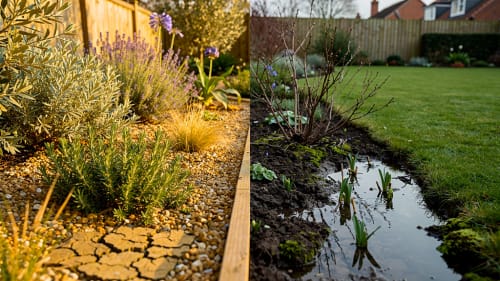
On sandy soil (Woking, Bagshot, Camberley): Sandy soils drain fast and warm early, which is an advantage for spring planting but means summer drought stress. Pair drought-tolerant companions: lavender with roses (the lavender attracts pollinators and the root zones don't compete as aggressively as they would in clay). Thyme as ground cover between paving or around the base of fruit trees works well here because it suppresses weeds, tolerates poor soil, and attracts beneficial insects.
On chalk (Box Hill, Dorking, parts of the North Downs): Alkaline, thin, free-draining. Companion planting here needs species that tolerate high pH. Wild marjoram with scabious and knapweed creates a pollinator and predator-rich planting that thrives on chalk. Avoid acid-loving plants entirely.
A practical approach
Rather than following rigid companion planting "rules," we take a principles-based approach in our designs:
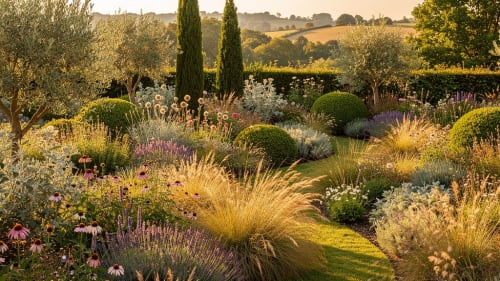
Mix, don't monoculture. Every border should contain at least three to four different species. This isn't just for pest management. It's better for soil biology, for visual interest, and for resilience when one species has a bad year.
Include umbellifers in every sunny border. Fennel, angelica, ammi, or achillea. They're the single most effective plant group for attracting beneficial insects, and they work in most Surrey soil types with minimal fuss.
Use trap crops deliberately. If you're growing vegetables, plant nasturtiums near brassicas and beans. If you're growing dahlias, accept that earwigs will be part of the picture and provide ground-level shelter (inverted pots stuffed with straw) to manage them rather than trying to eliminate them.
Let herbs flower. Many gardeners cut herbs back before flowering to extend the harvesting season. That's fine for some plants, but allow a proportion to flower. Flowering thyme, rosemary, and oregano are magnets for pollinators and predatory insects.
Accept imperfection. A garden with zero pest damage is a garden with no ecosystem. The goal isn't elimination. It's balance.
What we design into client gardens
When we plan a new garden or redesign an existing one, pest-resilient planting is built into the scheme from the start. It's not a separate consideration added afterwards. The species mix, the structural planting, the ground cover choices, and the inclusion of habitat features (log piles, rough areas, water sources) all contribute to a garden that manages its own pest pressures over time.
If you're thinking about a garden redesign or want to shift your existing planting toward a more resilient approach, talk to us about garden planning and design.
For a deeper look at how garden design decisions affect long-term outcomes, read what makes a garden design actually work.